eRide Waiheke Sustainability Case Study:
eRide Waiheke Transforming Visitor Transport on Waiheke Island
At eRide Waiheke, sustainability is not a side project. It is part of how we have built the business from the beginning. Our sustainability work is focused on one clear idea: how can we help visitors explore Waiheke Island in a way that reduces congestion, lowers emissions, and still delivers an outstanding experience?
That question sits at the heart of our eRide Waiheke sustainability study and the wider work now being recognised publicly through the Sustainable Tourism case study, “eRide Waiheke: Transforming Visitor Transport.”
Replacing higher-emission visitor transport with premium e-bike experiences
Waiheke Island is famous for its vineyards, beaches, and relaxed lifestyle, but like many popular destinations, it also faces the challenge of visitor transport. Too often, the default choice is rental cars or other higher-emission travel options. The opportunity for us was simple: make low-carbon travel the easier, more attractive choice.
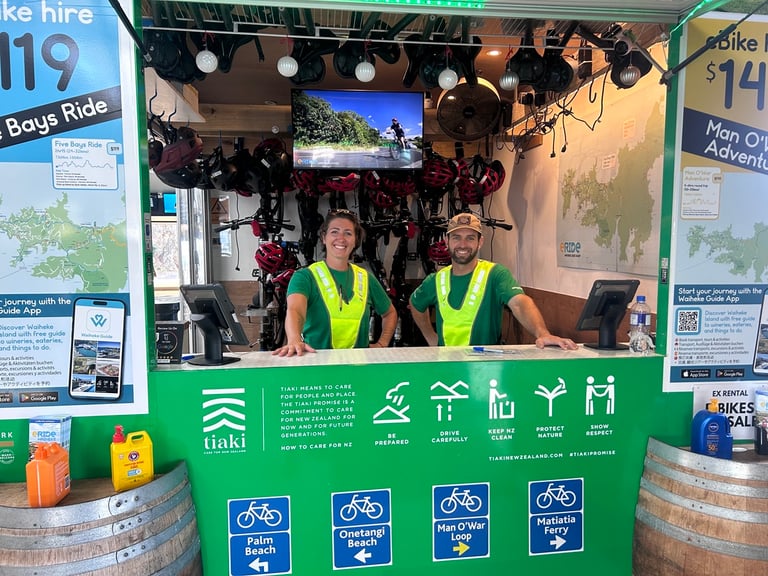
From our base at the Matiatia Ferry Terminal, eRide Waiheke has built a premium e-bike experience designed to help visitors explore more of the island without relying on cars. The Sustainable Tourism case study notes our fleet of 98 bikes and highlights our role as a locally owned micro-business working to decarbonise tourism while encouraging visitors to travel more responsibly.
The eRide Climate Counter and a fuller view of impact
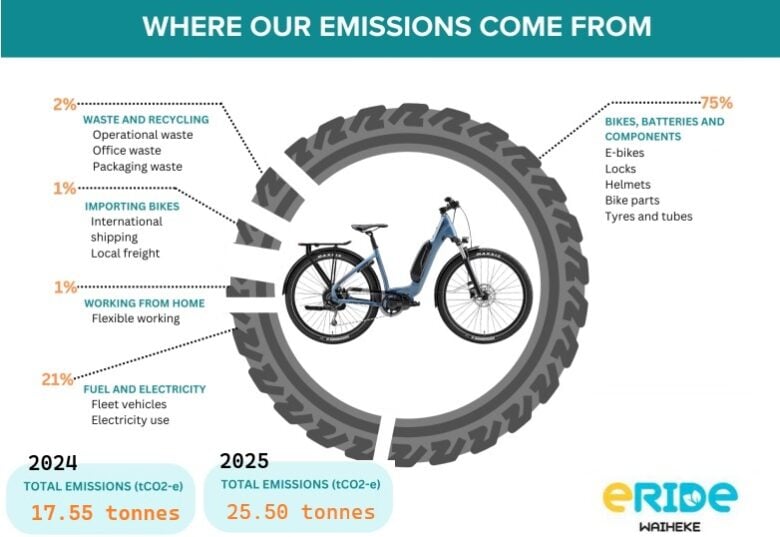
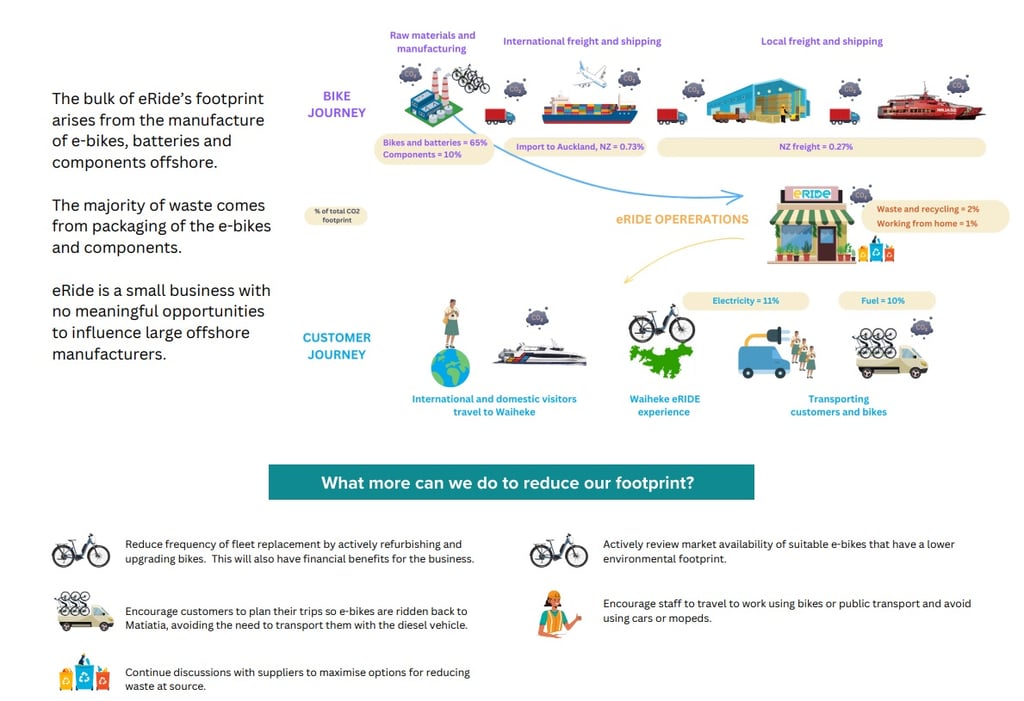
One of the biggest drivers behind our sustainability study has been transparency. E-bikes are naturally a lower-emission transport option, but we wanted to look further than that. We wanted to understand not only the emissions we avoid when visitors choose bikes over cars, but also the embodied emissions in the bikes themselves through manufacturing, freight, and long-term use.
That is why we developed the eRide Climate Counter, a custom-built emissions tracking system designed to measure emissions, emissions avoided, and the embodied carbon within our fleet. As outlined in the Sustainable Tourism case study, this work is also intended to support greater customer transparency through future CO₂e receipts.
For us, this matters because sustainability should be measurable. It should not sit in the background as a vague claim. It should help guide operational decisions, improve accountability, and show visitors that their choices really do make a difference.
Fleet circularity, longer bike life, and smarter operations
The sustainability study also reflects another major part of our approach: fleet circularity.
Our bikes are premium working assets, and we focus heavily on extending their useful life through maintenance, smarter component choices, and operational care. The public case study highlights that our model keeps bikes in service longer, reuses embodied carbon more effectively, and later allows many of those bikes to be on-sold to locals, creating an ongoing low-carbon commuting benefit beyond tourism.
This is a practical example of how sustainability and business resilience can support each other. Better components, longer service life, and lower turnover can reduce material inputs while also improving operational performance.
How the Waiheke Guide App supports lower-impact tourism
Our sustainability work is also closely connected to the Waiheke Guide App, which the Sustainable Tourism case study identifies as a key initiative. The app provides visitors with safe route information, real-time guidance, and responsible tourism information in multiple languages, helping make self-guided low-carbon travel easier and more accessible.
Better guidance changes behaviour. When visitors feel confident, informed, and supported, they are more likely to choose a self-guided e-bike experience over a car. That improves the visitor journey, supports wider dispersal across the island, and helps more local businesses benefit from tourism. The case study also notes that through community collaboration, eRide Waiheke has installed 30 wayfinding signs across key routes to strengthen safer, lower-impact travel.
Reducing emissions across the wider operation
Sustainability is not only about how our guests travel. It is also about how we run the business.
That is why reducing emissions within our own operations matters too. The Sustainable Tourism case study notes that eRide Waiheke strengthened its low-emissions operations by replacing two diesel vehicles with an electric truck, reducing the carbon footprint of the wider business.
This kind of change is important because a credible sustainability story has to include the operator as well as the visitor.
The results so far
The results published in the Sustainable Tourism case study are significant. In the 2024/25 season, visitors rode approximately 340,000 km on e-bikes instead of using cars. According to the case study, that avoided more than 85 tonnes of CO₂ and delivered a net climate impact of –61 tonnes CO₂.
The case study also points to wider visitor and business outcomes, including stronger visitor confidence, increased dispersal to other businesses, lower operating costs through reduced component turnover and fewer vehicle recoveries, and continued strong customer metrics including an NPS over 80 and a public review score of 4.9.
These outcomes matter because they show that sustainability does not have to compete with visitor experience or commercial strength. Done properly, it can reinforce both.
What this means for the future
For us, the sustainability study is not an endpoint. It is part of an ongoing process of measuring better, improving further, and sharing what works.
The wider lesson is that small tourism operators can lead. The Sustainable Tourism case study makes that point clearly: small businesses can think beyond the obvious, measure what matters, engage visitors in the journey, and collaborate with others to strengthen the destination as a whole.
That is exactly what we are trying to do at eRide Waiheke.
We are proud to be part of a growing shift toward lower-impact tourism on Waiheke Island, and we are grateful to everyone supporting that journey — our riders, our community, our partners, and the many businesses working toward a stronger visitor future.
Learn more
To learn more about the work behind the eRide Waiheke sustainability study, explore our sustainability journey, discover our e-bike experiences, or read the Sustainable Tourism case study on how eRide Waiheke is helping transform visitor transport on Waiheke Island.
eRide Waiheke Sustainability Study: Practical Action for Lower-Impact Tourism
At eRide Waiheke, sustainability is not something we talk about once a year. It is built into how we operate every day. Our eRide Waiheke sustainability study helps us better understand our impact, improve our systems, and keep moving toward lower-impact tourism on Waiheke Island.
As a premium e-bike tourism business, we see sustainability as more than simply offering electric bikes. It is about measuring what matters, extending the life of our fleet, improving visitor flow, reducing unnecessary transport emissions, and helping visitors explore Waiheke in a smarter and more responsible way.
This study supports the direction we have already been taking as a business. It gives us another layer of insight as we continue refining our operations, visitor experience, and long-term environmental performance.
What the eRide Waiheke sustainability study shows
The sustainability study confirms something we see every day: transport choices matter. When visitors choose to explore Waiheke Island by e-bike rather than relying on higher-emission alternatives, the impact goes beyond a single ride. It changes how people move around the island, how they connect with local businesses, and how they experience the destination.
For eRide Waiheke, the study helps reinforce the value of practical sustainability action. It highlights the importance of:
- encouraging low-impact visitor transport
- measuring kilometres ridden across our fleet
- understanding operational emissions
- extending the usable life of bikes and components
- reducing waste through smarter maintenance and servicing
- improving route guidance so riders travel more efficiently
This is important because sustainability in tourism should not be vague. It should be measurable, visible, and connected to real operational decisions.
Sustainability at eRide Waiheke is practical, not performative
At eRide Waiheke, we have worked hard to build sustainability into the way the business functions.
That includes maintaining and monitoring our fleet carefully, improving component durability, reducing unnecessary vehicle movements where possible, and using our own data to understand how bikes are being used across the island. It also includes looking closely at supply chain and operational emissions, not just the obvious day-to-day activity that visitors see.
Our goal is simple: make better decisions with better information.
That is why we have been developing the eRide Climate Counter, our own system designed to help us measure Scope 1, 2, and 3 emissions across the business, while also helping us better understand emissions avoided through visitor mode shift. For us, this is about accountability as much as innovation.
Why lower-impact tourism matters on Waiheke Island
Waiheke is a special place, and that means tourism here has to be handled carefully. Visitors come for the landscape, the beaches, the vineyards, the village atmosphere, and the sense of escape. Protecting that experience matters.
Lower-impact tourism is not just about carbon. It is also about reducing pressure on roads, improving the quality of the visitor journey, and helping people move around the island in a way that feels more connected and less disruptive.
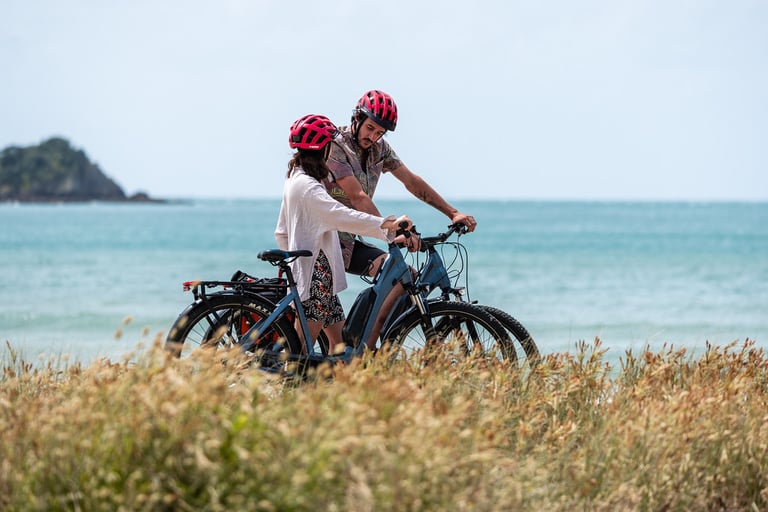
This is one reason e-bikes make so much sense on Waiheke. They allow visitors to cover more ground with ease, while staying immersed in the island itself. Riders are not just being transported through Waiheke. They are experiencing it directly.
How the Waiheke Guide supports sustainability
Our sustainability work also connects closely with the Waiheke Guide app. Better visitor information can lead to better visitor behaviour.
By helping riders navigate more safely and efficiently, discover local businesses, and avoid confusion or unnecessary backtracking, the app supports a smoother and more enjoyable day out. That improves the customer experience, but it also contributes to more efficient movement across the island.
When sustainability is done well, it often looks like better service, better planning, and less friction. That is exactly what we are aiming to create.
Small tourism businesses can lead by example
One of the strongest messages from this work is that small tourism businesses do not have to wait for someone else to lead.
Innovation does not always come from large organisations. Sometimes it comes from businesses close enough to their customers, their community, and their destination to see what needs to change and act on it.
At eRide Waiheke, we believe small businesses can play a meaningful role in shaping the future of tourism in New Zealand. We also believe visitors increasingly value businesses that can show real thought, real care, and real action.
What comes next
This sustainability study is not an endpoint for eRide Waiheke. It is another step in an ongoing process of learning, measuring, improving, and sharing what works.
We will continue refining how we track our impact, how we communicate sustainability to visitors, and how we use technology to support lower-impact tourism experiences on Waiheke Island. That includes the continued development of the eRide Climate Counter and wider tools that help make our sustainability work more transparent and useful over time.
We are grateful to everyone supporting this journey our riders, our team, our partners, our local community, and the wider network of businesses working toward a stronger visitor economy.
Every ride is part of something bigger. We are proud of the direction we are heading, and we are excited about what comes next.
Learn more about eRide Waiheke sustainability
If you would like to learn more about eRide Waiheke sustainability, explore our sustainability work, discover our e-bike experiences, or see how we are helping shape lower-impact tourism on Waiheke Island.